
Who Is at Risk of Kidney Disease?

Last episode, we looked at what your kidneys do — and why they matter.
This time, we shift the question. Not “what do kidneys do?” but “could something be putting mine at risk?”
Here’s the important part: knowing your risk doesn’t mean you have kidney disease. It means you know where to pay attention. And that knowledge — simple as it sounds — is often the difference between catching a problem early and discovering it too late.
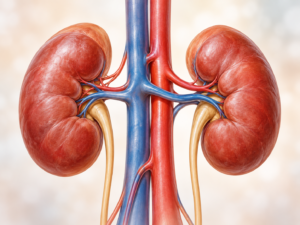
Human kidneys
WHY RISK MATTERS MORE THAN SYMPTOMS
Most people wait for symptoms before they think about their health. With kidneys, that approach doesn’t work.
Early-stage kidney disease is frequently asymptomatic. By the time symptoms appear — swelling, fatigue, changes in urination — a significant amount of kidney function may already be lost.
In the United States, approximately 9 in 10 adults with Chronic Kidney Disease (CKD) are unaware they have it. Although awareness varies between countries, this highlights how easily kidney disease can go undetected.
That’s why we focus on risk factors instead of symptoms. Risk factors tell you where to look before something goes wrong.
You don’t have to wait until you have symptoms to discover that your kidneys need attention.
THE LEADING RISK FACTORS
1. High blood pressure (hypertension)
This is one of the two most common causes of kidney disease.
High blood pressure damages the blood vessels and filtering system inside your kidneys. Over time, this reduces their ability to filter properly. And because damaged kidneys also struggle to regulate blood pressure, the problem feeds itself — blood pressure rises, kidneys weaken further, and the cycle continues.
In Nigeria, high blood pressure is particularly concerning. According to the World Health Organization’s 2025 report, an estimated 32% of Nigerian adults aged 30–79 had hypertension in 2024, and only half of those affected had been diagnosed. Because high blood pressure often causes no noticeable symptoms, regular checks are important.
2. Diabetes
Diabetes is a major cause of chronic kidney disease worldwide. Over time, persistently high blood sugar can damage the kidneys, often without noticeable symptoms.
High blood glucose damages the blood vessels in your kidneys. This is called diabetic kidney disease, and it develops gradually — usually over many years — often without any warning signs.
If you have diabetes, your kidneys need regular monitoring. This isn’t optional. It’s part of managing diabetes properly. You should get tested every year for kidney disease if you have type 2 diabetes, or if you’ve had type 1 diabetes for more than 5 years.
3. Family history of kidney disease
If a close relative — parent, brother, or sister — has kidney disease or kidney failure, your risk is higher.
Some kidney conditions are inherited. Others cluster in families because shared risk factors like high blood pressure and diabetes may be influenced by shared genes, environments and health conditions. Either way, family history is a signal worth taking seriously.
4. Heart disease
Heart disease is an established risk factor for kidney disease.
Heart disease, stroke, and heart failure are closely linked to kidney disease. The reasons overlap: shared risk factors, shared blood vessels, and the fact that a struggling heart reduces blood flow to the kidneys. If you have any form of cardiovascular disease, your kidneys deserve attention too.
5. Previous acute kidney injury
Chronic kidney disease generally involves kidney abnormalities persisting for at least three months, whereas acute kidney injury develops over a much shorter period.
A history of acute kidney injury (AKI) is a risk factor for chronic kidney disease.
If you’ve had an episode of acute kidney injury — a sudden loss of kidney function — your kidneys may be more vulnerable going forward. Previous damage doesn’t always heal completely. And even when it does, the underlying cause may still be present.
6. Obesity
Obesity is an established risk factor that can contribute directly to chronic kidney disease in adults. It contributes to the risk for high blood pressure, type 2 diabetes, and impaired kidney function, all of which often cluster together.
This doesn’t mean everyone with a higher body weight will develop kidney disease. It means weight is one factor among several — and one that can be modified. Managing weight if you have overweight or obesity can help slow the progression of CKD.
7. Smoking
Smoking can worsen kidney disease. In adults with chronic kidney disease, cigarette smoking is associated with an increased risk for CKD progression.
Smoking damages blood vessels throughout the body, including the small vessels in your kidneys. For people with other risk factors, smoking increases kidney and cardiovascular risk.
8. Certain medications
Some medicines — particularly certain painkillers — can harm the kidneys when used frequently or over long periods. The risk depends on the particular medicine, dose, duration and circumstances.
NSAIDs (nonsteroidal anti-inflammatory drugs) can damage your kidneys if you take them for a long time, or lead to acute kidney injury if you take them when you are dehydrated or your blood pressure is low. Ibuprofen and naproxen are NSAIDs.
This is not a reason to avoid all medication. It’s a reason to use medicines thoughtfully, especially if you already have other risk factors. We’ll cover this in detail in Episode 4.
Some traditional medicinal preparations may contain substances harmful to the kidneys. African chronic kidney disease research identifies nephrotoxic herbal remedies as an important concern.
9. Recurrent kidney stones with complications
Kidney stones with complications are listed as a cause of chronic kidney disease in adults.
Kidney stones themselves don’t usually cause permanent kidney damage. But recurrent stones — especially if they obstruct urine flow or lead to repeated infections — can harm kidney function over time.
10. Some infections and other medical conditions
Infections are listed as a cause of CKD. Certain conditions such as recurrent kidney infections, lupus, sickle cell disease and HIV can also affect the kidneys.
Sickle cell disease can damage the kidneys over time. It is especially relevant to health education in Nigeria.
If you’re living with any condition that can affect the kidneys, regular kidney check-ups are important.
TWO COMMON MISCONCEPTIONS ABOUT KIDNEY DISEASE
It is worth clearing up a few myths:
- Most back pain is caused by problems involving the muscles, joints or spine, rather than the kidneys. However, severe pain in the back or side—particularly when accompanied by fever, blood in the urine or painful urination—may indicate a kidney problem and should be assessed promptly.
- Having no symptoms does not mean your kidneys are healthy. Early-stage kidney disease usually has no symptoms. This is the most important point in this article.
KNOW YOUR KIDNEY RISK CHECKLIST
Go through this honestly. There are no wrong answers — only information you can act on.
- ☐ I have high blood pressure (If you don’t know your blood pressure, have it checked)
- ☐ I have diabetes
- ☐ A close family member has kidney disease or kidney failure
- ☐ I have heart disease, heart failure, or have had a stroke
- ☐ I’ve had acute kidney injury before
- ☐ I am significantly overweight
- ☐ I am older than 60 years
- ☐ I smoke
- ☐ I frequently use anti-inflammatory painkillers, such as ibuprofen, naproxen or diclofenac, especially without medical advice
- ☐ I’ve had recurrent kidney stones with complications
- ☐ I live with a condition that can affect the kidneys (e.g., sickle cell disease, HIV, lupus)
- ☐ I use herbal remedies
If you have one or more risk factors, it doesn’t mean you have kidney disease. It means you should speak with a healthcare professional about checking your kidneys. This may involve a blood test to assess kidney function and a urine test to look for early signs of kidney damage.
If you ticked none, that’s good news. But it doesn’t guarantee that your kidneys are healthy. Some people develop kidney disease without any obvious risk factors. Your risk for developing CKD also increases with age.
WHAT TO DO WITH THIS INFORMATION
Risk isn’t a diagnosis. It’s a direction.
If you’ve identified risk factors this week, the next step is not panic. It’s action:
- Check your blood pressure. This is quick, cheap, and available at most pharmacies and health centres.
- Know your blood sugar status. If you’ve never been tested, consider it.
- Talk to a healthcare professional about whether you should have kidney function tests.
- Keep reading this series. Episode 6 will explain exactly what those tests are and what they mean.
THIS EPISODE’S TAKEAWAY
- You don’t need symptoms to take kidney health seriously. You need awareness of your risk.
- Knowing your risk factors puts you in a position of control. It tells you where to look, what to monitor, and when to ask for help.
Next episode, we’ll move from risk to action — the everyday habits that protect your kidneys.
A QUICK REFLECTION BEFORE NEXT WEEK
- Did any item on the checklist surprise you?
- Do you actually know your blood pressure number?
- When was the last time you had your blood sugar checked?
If you don’t know the answers, that’s okay. That’s exactly why this series exists.
SOURCES FOR FURTHER READING
- KDIGO — 2024 CKD Clinical Practice Guideline. Read source
- National Kidney Foundation — Risk Factors for CKD. Read source
- NIDDK — CKD Tests and Diagnosis. Read source
- World Health Organization (WHO) — Global Report on Hypertension 2025. Read source
- Centers for Disease Control and Prevention (CDC) — CKD in the United States, 2026. Read source
- Wiley Online Library
- American Kidney Fund
Editor’s note: This article is for general health education and does not replace personalised medical advice from a qualified healthcare professional.